
A comprehensive analysis of biodiversity

With its bright red flowers, the summer pheasant's eye adds a dash of colour to fields and meadows – provided you can find it. “Merely a few decades ago, the pheasant's eye used to be a typical companion plant of winter cereals,” Professor Helge Bruelheide says. “Now, it has all but disappeared, along with other wild herbs such as black cumin, Venus’ comb, corn cockle, and hare's-ear.” The main reason for the extinction of species is the increasing intensification of agriculture, with meticulous seed cleaning, massive use of herbicides and fertilisers, and a lack of crop rotation. “Our students are probably the final generation to experience these wild herbs in our cultural landscape.”
Helge Bruelheide is the Chair of Geobotany and the director of the Botanical Garden at MLU. And he is one of Germany's most renowned biodiversity researchers. Together with researchers from the universities of Leipzig and Marburg and the Helmholtz Centre for Environmental Research (UFZ), he published the “Faktencheck Artenvielfalt” (German Biodiversity Assessment), the first comprehensive analysis of the state of biodiversity in Germany, in 2024. More than 150 scientists from 75 institutions and associations cooperated in working on it and evaluated over 6,000 publications. “Generally speaking, there is great awareness for the problem of species extinction. However, up to this point, no comprehensive survey has yet been carried out on the specific situation of the plant world in Germany,” Bruelheide explains.
To identify long-term developments, an unprecedented data set of around 15,000 trends from almost 6,200 time series was created and analysed for the assessment. The sombre result: Nearly a third of all examined native animal, plant and fungus species are endangered, and about three percent are already extinct. In numbers, this means: More than 10,000 of the 72,000 species present in Germany are endangered. More than half of the natural habitat types in Germany are ecologically unstable, and more valuable habitat areas are disappearing every day. The situation is worst for arable land and grassland, moors, moor forests, swamps, and springs, which used to be hotspots for biodiversity.
Back in 2022, researchers at MLU already presented some insights that can be gained from time series data. They had compiled a wealth of local studies from Germany, some of which had not yet been published. More than 7,700 plots were examined, whose plant populations – around 1,800 species in total – had been recorded multiple times between 1927 and 2020. The analysis was published in “Nature” and revealed a significant loss of diversity: The populations of 1,011 of the species examined had declined in the course the last one hundred years, while 719 had increased. Counting among the winners of this development are bird cherry, red oak and holly. The major losers, on the other hand, include wild herbs, meadow flowers and wetland plants. The researchers date the beginning of this development to the late 1960s, a clear correlation with the strong intensification of land use at that time.
Both the German Biodiversity Assessment and the study published in “Nature” reveal a fundamental problem with previous biodiversity research: there is hardly any valid data on the same habitats over time. “Thirty-seven years ago, I analysed the species diversity of calcareous grasslands in the Meißner region in northern Hesse for my diploma thesis and noted every plant in designated areas, including those that were not flowering at that time,” Bruelheide reports. “Later, I regretted that the areas had not been marked, so that changes over the years and decades could have been documented. Since my doctoral thesis on the mountain meadows in the Harz, we have been surveying and marking the areas.” In addition to a lack of long-term documentation, geobotanical research is additionally hampered by the fact that there is no standardised system across species and habitats that allows the linking of different data.
The German Centre for Integrative Biodiversity Research Halle-Jena-Leipzig, iDiv for short (see info box), is working on overcoming these deficits. Helge Bruelheide co-founded the centre, which is funded by the German Research Foundation (DFG), in 2012 and has played a key role in its development. iDiv aims to combine research data from various initiatives dealing with plant diversity in ecosystems. In the sPlot project, for example, vegetation data from around the world is being transferred to a harmonised database. sPlot already contains 2.5 million data sets with complete lists and quantity information on plant species that occur together in a wide variety of ecosystems around the world. Bruelheide: “The integration of international vegetation data enables us to understand global patterns of plant diversity.”
Even if the data on global species diversity as a whole is alarming, there are positive developments, too. In Germany, for example, the authors of the biodiversity assessment found a significant improvement in the water quality of our rivers and, as such, also in the living conditions of the flora and fauna near the water. “We are seeing more species of dragonfly than 30 years ago,” says Bruelheide. “This demonstrates that environmental policy measures, such as wastewater treatment and the renaturation of watercourses, can have lasting effects.” He says, the idea that biodiversity only creates costs is a very limited view: intact natural landscapes are essential for tourism and for our well-being, and the transition to resilient agriculture will help to ensure our food supply in the future. “Diversity in fields and meadows reduces the number of crop failures; soil that is used carefully, needs less synthetic fertiliser, and a lower seed density is attractive for ground-nesting field birds.” And, what is more, it leaves more space for endangered wild herbs, such as the summer pheasant's eye.
The iDiv
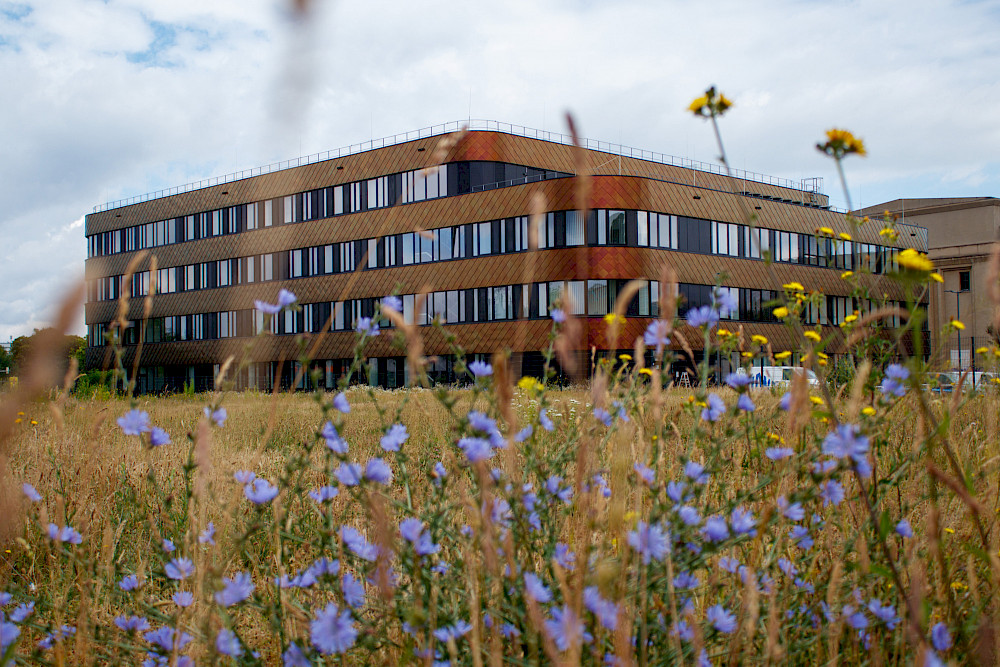
The German Centre for Integrative Biodiversity Research (iDiv) Halle-Jena-Leipzig was founded in 2012 to study the changes of ecosystems and biodiversity. The MLU is represented with numerous outstanding researchers: Professor Jonathan Chase, an expert in combining large data sets on distribution of species, received an Advanced Grant from the European Research Council in 2023. Professor Henrique Pereira is a member of the Intergovernmental Platform on Biodiversity and Ecosystem Services and is working to make research results usable for political decision-making processes. The German Research Foundation (DFG) funded iDiv until 2024. In the future, Saxony-Anhalt, Thuringia and Saxony will secure the financing of the world-renowned research centre alongside the supporting institutions – MLU, Friedrich Schiller University Jena, Leipzig University, and the Helmholtz Centre for Environmental Research (UFZ).
Further articles
The wealth of data of plant researchers
Which plant species grow where, alongside which others - and why? Researchers at the University of Halle and the German Centre for Integrative Biodiversity Research (iDiv) Halle-Jena-Leipzig have the answer. They have set up the world's first global database on the earth's vegetation. Professor Helge Bruelheide, head of the international project, explains what can be explored with such a wealth of data. Read more